 Check issue #20 on newstands this week. Todd Allen was whipping a bone colored Waxwing Senior (2.1 oz) and hooked an unexpected brute on light gear. He was knocked down by a wave as he attempted to land it, got up, and eventually secured this giant Kagami ulua. You’ll be surprised to hear what he did with it after this picture was taken.
Smaller moon, rising tide = more fish activity
 Last Wednesday, I kayak fished the deep Windward waters and didn’t even register a nibble. The nearshore fishing has been slow this Winter but that skunk really made me feel “kill fight”. Yesterday was forecast to have the lightest wind – best tide combination of the week so I made it a gear testing day, telling myself that the fishing was incidental. I took the old Scupper Pro out, which hadn’t touched water in more than 10 years, and used a heavier weight to keep the live oama down deep.
After the afternoon showers stopped, the wind completely died down. Not a fair comparison with the chop and slop conditions of the Aquaterra Swing’s last outing. I was worried the Scupper Pro would be tippy since it’s a lot narrower than the Swing, but because the seat sits lower to the water, it reminded me of sitting on a surfboard with my legs in the water. The Scupper Pro also paddled much easier due to its longer length and narrower, rounded hull. The Swing, in comparison, has a flat hull that feels like it’s pushing water, not knifing through it. The SP’s cockpit did feel cramped compared to the Swing’s, but I eventually got used to it.
There were a lot more tiny bait fish and suspended reef fish on the fish finder than last time. I braced myself for a strike on the trolled oama but none came. Hmmmppphhh. Well, since this was supposed to be a test of the Scupper Pro, I paddled further out than I had been fishing recently, enjoying the glide of the long, slender craft. The heavier fishing weight seemed to be keeping the oama down better, without getting hung up on the bottom. I slow trolled over numerous little bait collections but no predators felt like eating an oama with a hook in its nasal cartilage.
 Finally something pulled the tip of the rod down a couple inches, then pulled drag. The fish seemed to be shaking its head but the vibrations were a little too frequent to be papio head shakes. I pictured an awa awa swimming in such a way that its large tail was slapping the line. Sure enough, after some powerful runs, I was able to short pump the fish to the surface. About a 4lb awa awa with its weird transparent forehead greeted me. I think awa awa pull harder, pound for pound, than omilu and whites, but once you get them boat side they’re pretty tuckered out.
It felt great to land a decent fish again. I dropped down another oama and a few minutes later something pulled some line off the reel. In my peripheral vision I could see a smaller fish leap out of the water. That was the first awa awa that jumped in the deep water, and it was able to shake the hook and gain its freedom.
Fish began to puddle on the surface and I expected more action but alas, the bite stopped. I took advantage of the glassy conditions by trolling through other promising spots, and dropped the flat fall jig down on bait pockets but nothing wanted to eat.
So why was there more bait and predator activity than last week? The moon was smaller, being 7 days after the full moon rather than just 2 days. And I was fishing the first third of the rising tide instead of the last third. The heavier weight was keeping the bait in the zone longer. And the glassy conditions made it much easier to fish. Why do you think it was better this time around?
Big moon, big swell, choppy conditions = no fish
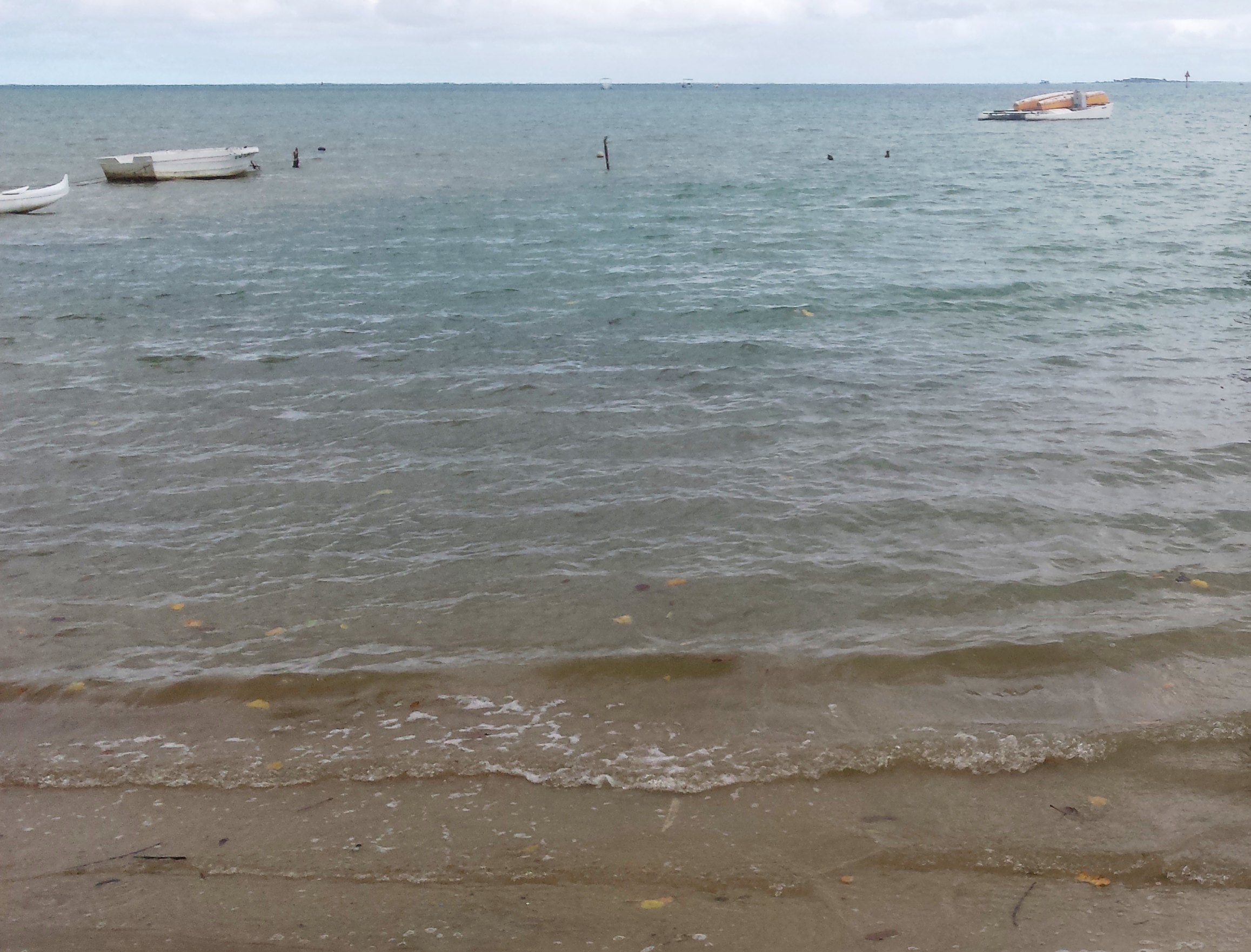 According to iWindsurf.com, the Windward side yesterday was supposed to have relatively calm wind conditions. I picked a spot protected from the booming North West swell and was expecting close to sheet glass conditions. Instead my launch spot looked like this from the afternoon onshore winds.
Since I had schlepped all my kayak gear I was committed to paddling out. Heading into the wind and chop was definitely slow going and at times, small waves were cresting into my kayak. Not ideal conditions at all. I trolled a live, captive oama looking for bait schools on my fish finder. Bait was hard to find and the few suspended fish above the schools didn’t want to eat the oama or flat fall jig.
I trolled the outer papa edges, the deep channels, the inner sand beaches and came up empty. Not a single critter touched the oama. This had never happened anywhere before.
Was it because the full moon was two days earlier and the fish were feeding at night? Or did the epic swell that caused the Eddie Aikau Contest to run today cause the fish to hunker down for safety? Or maybe the windy conditions caused me to miss running over the fish with my fish finder? I sure hope conditions improve next week.
Live oama comes through on a slow evening
Took the kayak out with two rods, one to troll live captive oama and the other to fish the Shimano Flat Fall jig. The tide was falling to a minus tide at around dark, and sure enough the fish and bait activity was almost non-existent. Something hit the live oama but wasn’t strong enough to take drag. It unbuttoned before I could see it.
I slow trolled the reef dropoffs hoping for a strike on the oama, and for a bait ball to show up on the fish finder. No strikes. When I found suspended fish I dropped down the 2.8oz flat fall jig and quickly realized my 6.5ft fiberglass/graphite blend bass rod was too soft for the heavy weight of the jig, and potentially strong fish that might eat the jig. 40 feet of water might be too shallow to fish that sized jig. It fell pretty fast and didn’t stay in the strike zone long enough, on the retrieve. I think I need a heavier action rod, and need to fish it in deeper water.
 The evening witching hour arrived when the fish normally feed before dark but I couldn’t find the bait school. The falling low tide must’ve changed the fish behavior. I worked my way in, and out of desperation, paddled across a large channel to the opposite side of where the bait normally congregates. I began to see fish suspended two deep off the bottom and finally got a hookup. The fish was vigorously shaking its head all the way through the fight so I suspected it was a trumpetfish or needlefish (aha). I was thrilled to see a thrashing white papio that was trying to shake off the hook barely attached to its lip. It later taped out at about 14″ head to fork.
The bait school was holding near the bottom, and larger fish were suspended above it. I dropped the flat fall jig again and didn’t get a hit. When I stowed the flat fall rod away, I couldn’t find the bait school again and it was getting dark so I headed in. Oh well, I learned a new spot the bait school may use.
One mystery sea monster unmasked
During the winter “off season”, I’ve been fishing the deep water Windward spots. Haven’t landed a decent fish in the last 3 outings. Each time I had a big strike that either broke off or slipped off. So I went back to the general area where I got the awa awa a few weeks ago, and fished the slight tidal rise in pure glass conditions. I headed away from the area that had been productive, and paddled around for nada. Nothing wanted to eat a slightly tired, tub-raised oama.
When I returned to the previously productive area, my fish finder lit up with fish on the bottom and fish breezing near the top. I slowed to let my oama sink to the bottom and sure enough something pulled against the hard drag for a few seconds. The oama was gone but the two hooks were left intact. This happened 2 more times even though I made the drag really tight. I found out what this strong armed Houdini was on the next strike.
I got a hit near the papa (reef) edge and the fish ran faster than a papio normally would. It fought the tight drag for a while and stayed deep. I could see the oama’s white color but couldn’t see what was under it. When I finally began to see color, I saw fluorescent blue fins and a tail. A long omilu perhaps?
Arrghh, no, a big crocodile needlefish or aha, nicknamed “blue bone” because it has blue-green bones. These fish have been known to jump out of the water and unintentionally (we hope) spear people in the head and chest, causing a few very unfortunate deaths.
 Not sure if you can tell how large the fish was, next to the kayak with the oama still on one of the hooks, but it was somewhere between 3 and 4 feet. The rear hook is in his jaw but he had bitten off the line connected it to the front hook.
 If you look at his top jaw, I think those cuts were from each successful attempt to steal the bait. So this is the guy responsible for all the hard strikes and lost fish I’ve been getting. Kill fight yeah?
Well, I had a few more live oama so I lowered one down the side of the kayak and immediately hooked up. Ugh, another aha since I was right on the papa edge? But no, this fish pulled a little slower and more steadily; it could even turn the kayak.
 I was pleased to see a lightly hooked, 2lb plus awa awa. I looked at my watch and it turned out that the flurry of action happened right at the peak high tide and ended 30 mins later. I guess aha and awa awa like the slack high tide so they don’t have to fight the current. Kaku are lazy like that too.
So now I know what’s been ripping drag and stealing baits. I did have a strong fish cut me off on the reef, and a really heavy creature pull me around for 20 minutes. Guess I need to go back and solve those mysteries.
More sea monster action
Kelly joined me on the Windward sea monster hunt today. He was on his SUP, using his shorts as a rod holder, and I was on my heavily loaded kayak. Kelly landed a 12″ omilu right off the bat whipping a live tub-raised oama, then the action really slowed for us. There wasn’t much life at the drop off so we paddled out to the fringing reef but I bailed when I saw small surf coming in. I overshot our landing spot coming back in and had to paddle upwind for half an hr. 3 hrs elapsed during this round trip and we were beat.
We still had some live oama left so despite being tired and hungry, we decided to use ’em up near the drop off. At the inner reef channel edge, Kelly chummed pieces of frozen oama and soon enough a 2lb omilu picked through the chum line. Kelly fly lined a live oama on the bottom of the channel and something big picked it up and slowly swam off with it, settled to the bottom for awhile, then pulled hard in spurts. As Kelly tried to slow down the sea monster, the line parted above the long leader. Was it the same sea monster I hooked a few days ago? My sea monster was hooked about 40 yds away from the drop off and behaved differently.
Down to my last live oama, and with no bites to speak of all day, I decided to fly line it since that technique worked well for Kelly. I slow trolled, hugging the drop off edge, and just as I was rounding the corner to come in I got a hit that screamed the ratchet and pulled the rod down on the rod holder, into my shoulder. I instinctively picked up the rod and started cranking but the wind blew me onto the reef. I felt the sickening rub of the reef and threw the rod back in the rod holder and paddled into deep water. When I picked up the rod again, I could feel the line running through a rock pile at the bottom of the channel. Ugh… I tried to free the line but it popped seconds later. This fish wasn’t the sea monster. It felt like a big, 5 lb plus omilu that was smart enough to cut me off instantly. I should’ve paddled for the deep water when the fish hit instead of fighting it above the reef.
We’ll be back, properly loaded for bear. Or sea monsters.
Hooked and fought a sea monster for 20 minutes
I’m sorry, I don’t have any photographs to back up the story I’m about to tell you. Gonna try to be as objective as I can be, and you can tell me what you think I hooked.
I was fishing the deep lagoon on the Windward side, about 40 yds past the reef drop off. I dropped a live oama, hooked through its nostrils, to the bottom in about 40 ft of water, and began to slowly paddle the kayak away from land. The bait was probably in the mid-water column when something hit and pulled drag at a medium-fast pace. The creature ran for the bottom and then out away from me. It easily pulled line in smooth spurts, but slowed after 50 yds or so. I was able to gain some line, and then it would pull line again, but never ripped line too fast or went too far. It felt like a huge awa awa at first but an awa awas would’ve taken more line.
There were large turtles around so I began to worry that I had hooked one of those. I tightened the drag to bring the “turtle” up, or pop off the hook, and the creature just powered for the bottom again. It was so strong I had to straddle the kayak to prevent getting tipped. It swam out away again, and I thought I thought I felt tail pumps and head shakes. For awhile it circled deep below me and I had extend the rod to clear the stern (back) and bow (front) of the kayak. An accidentally hooked turtle would’ve surfaced eventually but this thing wanted to stay as deep as possible.
I began to suspect it was a large sting ray, although I had never hooked one before to know how one would feel. It stayed down deep and swam back to the reef’s edge but stopped about 10 ft away from it. I was worried it would cut me off on the reef so I tried to muscle it up. About 2/3 of the way up the 15 lb fluoro leader cut. It was frayed just a bit, a few inches from where it cut above the hook. I never got to see color.
The creature didn’t head shake much, like a papio/ulua would, but it also didn’t just rest on the bottom like large sting rays like to do.
After retying, I paddled over a bait school suspended off the bottom, let my bait sink and sure enough I got a strike. The rod bounced like a papio hit the bait, but all that came back was the oama head on the single hook. I changed to a double hook setup and hooked a 10.5″ (FL) white papio and that was the end of the action.
What do you think the sea creature was? I would like to think it was an ulua, hunkering down on the bottom.
Last ditch attempt to catch something/anything; taegu recipe included
The inshore bite really slowed in the late December, early January time period. The 8 – 1o inch omilu have shown up sporadically but the larger ones appear to have gone wherever they go during the winter. Awa awa have been saving the day for Kelly, as he nimbly trolled dead oamas between sets on his SUP. Lacking the paddling speed and courage, I fished away from the impact zone on my longboard with not much to show for it.
 As a last ditch attempt to find a feisty predator, I kayak fished the deep waters of the Windward side solo today. The winds were very light, and armed with live tub-raised oama, I had high hopes. After an hour of aimless paddling I finally got a strike. It felt like a decent omilu, but it broke the surface halfway into the fight. What I thought was a short awa awa turned out to be a pretty large lai. My family doesn’t eat lai so I shook it off the hook.
Hopes raised, I paddled through bait marks on the fish finder, skirted the edge of dropoffs, and even dropped my oama to the bottom. Nada. The evening witching hour came without any predator activity and I dejectedly paddled for home. As my landing site came within view, my ratchet finally screamed. I hoped it was a thick papio but suspected awa awa in such deep water. The fished towed me a bit and spun me around before I could see color. Awa awa it was, and it saved the trip for me.
 It taped out at 26 inches (forklength), not as large as the previous one I caught here in the summer, but my first keeper of any kind in 3 trips. The papio continued to prove elusive.
 Chester made lomi lomi awa awa out of the fish and said it had a delightful fresh, mild taste. With the left overs he made taegu for us, using recipe below. Yummm!
This taegu recipe had been featured in Lawai’a magazine. Chester uses a small convection oven and dries on the lowest setting. He puts it outside so it doesn’t stink up the whole house. Genius! Oh, and he only uses a half teaspoon of chili pepper flakes. Adjust that to your heat tolerance.

There’s still some papio around…
…but most are the smaller variety (10″ – 12″ fork length) and they’re much pickier than they were a month ago. They want live natural baits, or you have to venture further out to find the less picky ones. Find the source of food for them, throw a natural bait out, and they’ll still bite.
Check out the shoreline areas that received the benefit of last week’s rain. Limu and crustacean colonies may have restarted, bringing the baitfish and predators back in.
Lemme know how you guys do!
Live vs. Recent Frozen vs. Year Old oama
The fishing conditions weren’t ideal today. 20 mph plus winds prohibited board fishing and the 0.4 ft low tide was in the middle of the day. I fished the spot that gave up the legal omilus two weeks ago, but the bite was very slow on the recently frozen oamas. Humuhumus chewed off the back end of some of the baits and a large cornetfish was the only thing hooked in the first hour.
 I could see a guy fishing the same stretch after I passed through, and it appeared like he was landing keepers with live oama on a floater. With the sun high in the sky the papio were getting a good look at the baits and shunning mine. To make matters worse I ran out of the 2015 frozen oamas and had to resort to a batch of freezer burnt, previously thawed oama from last year. They were gray and mushy and barely resembled the pastel colored juvenile weke. I was expecting even the humuhumus would shun the stinky bait but something hit and pulled hard. The drag was almost locked down to pull snags free, and the reel released line jerkily. It still didn’t feel like much until I saw the hooked omilu followed by its mate.
That papio must’ve felt foolish falling for a stinky, mushy oama. It taped out at 12 1/4 inch (fork length) and was the second and last fish I caught today. I had really wanted to catch a papio to give to a friend tomorrow and was stoked. On a day when the papio were picky, and last year’s oama was barely fit for fertilizer, the ocean yielded dinner.
Was this slow day yet another indication that the papio season is trying to draw to a close?
Season and habitat change
Continuing my survey of spots in the area, I fished a spot I hadn’t visited since June. The tide was higher than ideal so I could only walk halfway out to the break. It felt like I was walking on piles of rocks and I could feel the sharp points through my tabis. Only when I returned to shore did I realize the sand had eroded drastically.
The shoreline was covered with the kind of limu that grows in areas of fresh water influx, and what was once a murky area was crystal clear. The bait fish schools were absent and so were the larger predators. I saw a kaku follow my bait, and a few 3 inch omilus were bravely trying to pull off the oama, but nothing was hooked.
Looks like winter has arrived at that spot, and the lack of the silty sand removed the environment predators hid in.
Papio still around in mid-November
I wanted to determine the spots that still held inshore papio this late in the season so I checked another spot I hadn’t fished all year. The spot was an area I had trolled oama in the past but was never really good near shore.
 I wasn’t expecting much so I was really surprised when I hooked a 12″ (fork length) omilu on the second cast, just a few yards from shore. The omilu looked like it had been eating well over the course of the summer.
 After this surprise fish I didn’t hook anything else as I worked my way down the shoreline. I worked my way back and caught a slightly longer omilu about 5 yds from where the first was caught. This one was considerably fatter too so there must be a reliable food source nearby.
I decided to save my remaining frozen oama for a survey of another spot and called it a day. It was great to know papio were still catchable so late in the season, so close to shore.
Papio season continues… in other locations
My regular wading and board fishing spots haven’t produced in the last 3 weeks despite the Hawaii Fishing News calendar forecast saying that omilu are supposed to be inshore through November. Out of desperation, I fished an area I haven’t fished in almost two years just to see if there might be some hold over papio.
The water was clear on the rising tide and I could see tangs and humuhumus flitting around at the dropoff, and small ahas and trumpetfish were following my dead oama back to shore. I was encouraged by all the life I was seeing, but had to unhook many a slimy trumpetfish before the better fish showed. Sub-legal omilus pulled off the oamas, and moana nipped at the baits but didn’t get hooked. Then I landed a few just legal omilus and let them go.
 Finally, I hooked an omilu I knew was easily legal. It went 12.5″ from head to fork and I bagged it. From then on, 10.5″ omilu kept taking the baits so I kept a couple to pan fry. The “recruitment” class of omilu the last two years was so large that there are a lot of omilu 12 inches and smaller competing for a not-so-good recruitment class of juvenile reef fish. Harvesting some legal omilu will help reduce the predator burden on the bait supply.
I’ve been hearing report of papio being landed around the island despite what I had thought was the end of the papio season. Looks like it just ended in the area I was frequenting.
Papio Season is really over…
…at least at my spots. I didn’t want to accept the possibility that the bigger predators aren’t hunting inside the reef anymore so I took my board out during the high tide to fish a previously productive spot. I had even less action than yesterday’s low tide evening session. A few pulled baits and some kaku bites. One 7 inch omilu.
What an odd El Nino papio season it turned out to be. The oama came in later than normal and were skittish during the stormy, humid period. The papio caught inside the reef were weak and skinny like they were treading water in a sauna too long. Then the storms passed, the strong trade winds returned, and the inshore water cooled. New oama swam in, and bigger than normal papio began hunting them. The inshore fishing was fabulous for a few weeks and then it came to a dead stop. Although there have been reports of straggler oama piles around, the papio aren’t bothering to make the swim in. I wonder what triggers them to hunt inshore and then suddenly stop.
Guess we can return to our normally scheduled Fall lives.
Papio season may have ended…
The water cleared after last week’s murky conditions so I waded out to the same area that had been slow. I was really hoping the papio bite would continue full bore, but alas, I started with mystery fish pulling my dead oamas off the hooks. Then some oama came back with their back half sliced clean off. Next, hooks were bitten off. I’m guessing small reef fish and small papio were the bait pullers and kaku were slicing the baits and biting off the hooks.
After an hour of bait mangling and no fish to show for it, I cast from the reef edge of a deep sand channel leading to the open ocean. The sun was getting lower and large and medium kaku were competing for my dead oama in the light blue water. Miraculously I had some on without getting cut off, but they spit the hook. Then I hooked a medium sized kaku at the tip of his upper jaw such that he couldn’t bite the line. It was pretty tricky to grab the hook with long pliers and shake him off without getting nipped in the process. Tired of the kaku frenzy I positioned myself to cast to the right side of the channel.
I put on a beautifully preserved, large oama that still looked alive. It cast well because of its weight, and was hit solidly. The back half of the oama was raggedly torn off by something that didn’t have precision cutting teeth. Left with first 3 inches of the oama, and the sun setting, I threw the severed bait out again wondering what would want a fish head. Something slammed it, pulled against the stiff drag and jumped in the distance. I figured it was a kaku angry it didn’t get away cleanly with the tailless oama.
But the fish continued to pull drag and after it turned and swam up the reef shelf into waist deep water, it jumped again. Awa awa! I had never hooked one in this location and had no idea they came in here. It shot away after seeing me, but instead of going out into the deep channel it ran parallel to the beach and took at least 100 yds of line, taking me well into my braid backing. I felt confident it would tire out eventually but then I felt the rubbing of the line against a reef papa and sure enough the line got stuck. When I pulled, the line came back with no fish. At least 20 yds were shredded and stretched. Shucks, my dad would’ve really enjoyed the awa awa fish cake.
I had gone through 12 fresh dead oama and only landed a kaku. Sheesh. I put on a frozen oama and it got pulled off. By then the sun had set behind the mountains and I headed back in while there was still ambient light.
I guess this means the papio season is officially over. The reef fish, small papio and kaku will still be around to pester the baits but it sure looks like the big omilus won’t be hunting inside until next season. I would settle for a hard fighting awa awa until the papio return, though.
Did the papio season come to a dead stop, or just hit another pause?
In talking with other lure whippers and oama dunkers, and from my own experience, the papio season has been red hot in the last few weeks. Larger than normal papio were being caught inside the reef, some even reaching small ulua status.
With high hopes, I fished two previously productive oama whipping spots this week with Jason, who normally whips plastic grubs, Waxwings and other hard plugs. The first spot’s calm inshore area was a strange tea color. Just last week it was loaded with hungry whites. The bite on the dead oamas was very slow and only kaku were hitting far inside of the break. Jason ended up with a couple 15 – 20 inch kaku and I just had gouged and cut off baits to show. Convinced the papio had to be around somewhere I inched closer and closer to the waves and got splashed up to my cap multiple times. My waterproof bag proved to be not so waterproof when I had it opened to get more bait, and I ended up soaking my main reel and backup reel.
The following day, after taking apart both reels and lubing them with anti-corrosion lube, we hit a spot that had been red hot last week. The inshore protected areas were tinged brown like yesterday’s spot. An 8 inch omilu hit my first dead oama so things were looking up. But for the next hour or so, small papio nipped and pulled off the oama baits, a larger papio took drag and unbuttoned and we were inching closer and closer to the impact zone. I was tripped up twice in surgy water, falling head first in waist deep water with my rod in my hand. The first time I fell so suddenly my neck felt like I had whiplash and I had to massage out the tight muscles. I had never fallen wading to the break before; what the heck has been going on these last two days? Guess I’ll be finding out how good the anti-corrosion lube is.
Where did all the larger oama-eating papio go? Jason switched to plastic grubs and caught a few small omilu but even they were fairly scarce. Did the season come to a sudden end or did something else cause the predators to stop chewing?
White papio caught whipping dead oama
The wind was much lighter than yesterday so I tried the spot I waded out and whipped last week. The waves were small enough where I could sit just inside of the white wash, or in a small channel and cast into the surf. It took a bit of paddling around to find the biters, but once I found them, there were others nearby.
The first papio was a skinny, just legal omilu which I released. The next was a white papio of about the same length but thicker and more muscular. Unlike the omilu, it kept fighting even when I had it board side. The next papio was about 10.5″, head to fork and I considered keeping it but as I readied my fish bag it came off the hook. Oh well, I was just thinking of taking it since the fish seemed to all be the same size.
I cast out a rock hard, frozen oama and the fourth papio took it head first. It was just legal but hooked deep and I didn’t risk killing it by yanking out the hook with pliers so I cut the line off in front of the hook. Hopefully the hook rusts out or falls out soon.
With so many barely legal fish, I paddled around looking for a deeper spot to safely fish. I dug around for a larger oama that still had its colors, and tossed it out. Bam, a much stronger fish hit. The white papio kept fighting even when I had it next to the board. Omilu seem to pull faster and whites pull more doggedly. I happily bagged it.
With a nice white in the bag I went exploring and fished some unproductive water. Then I discovered an area next to the impact zone where the swell rolled through without breaking. I situated myself near the edge of the impact zone and cast another frozen oamasickle. Hookup, and the fish pulled me towards the waves. Yikes! I put the rod in the rod holder and paddled towards calm water hoping the fish wouldn’t rock me. When I reached calm water, I sat up and started cranking. The white, which was initially taking drag, wasn’t nearly as large as I thought. Man these whites can pull hard.
Pretty good action for a spot I’ve never board fished before. I headed in to keep the papios in good condition. Didn’t lose any rigs this time unlike the snaggapalooza yesterday.
 Interesting that, although the larger fish below is just an inch longer than the smaller one, its body is deeper and more angular to make room for its sex organs. It fought considerably harder also.
Challenging weather conditions, fish still bit
Dean and I board fished this morning since the wind was supposed to be less than 15 mph. Contrary to that forecast there were gusts over 20 mph which made it hard for Dean to stand up and paddle. The wind had less effect on me since I paddle lying down on my longboard, but I was still affected by the chaotic swell.
Dean trolled a dead oama behind a floater the way I used to, and I sat on my board as close to the waves as possible and cast into the surf. I got more strikes than he did but also got stuck a lot more since my prototype oama whipping rig sinks. I suspected fish were hitting the oama and pulling it into the rocks since I would pull some snags out and everything came back except for the oama. When I pulled an eel out of the rocks my suspicions were confirmed.
 Dean caught the first fish, a non-legal omilu, and then we both started getting hits, misses and cut lines. Seemed like other reef fish were pulling off the oamas, and kaku were cutting us off. I finally stuck a good fish and it ran in a funny way which made me think it was a big stickfish or cornetfish. I was relieved to see the color of a beautiful 2lb omilu. I finally made use of my gaff by lifting the omilu out of the water by putting the gaff hook through its mouth and out its gill.
The wind picked up and it was hard to effectively fish the surge zone. My next papio ran through the rocks and popped my line. Dean was getting occasional hits but having a harder time paddling upwind from his knees. It was time to head in.
I had quickly gone through 4 whipping rigs and 15 dead oama.
It was more fun to feel the strikes of the fish while whipping the oama but I definitely lost more tackle than I do when I troll with a floater. I’ll have to work on the prototype whipping rig some more.
Waxwing Baby works right out of the box
Charles contacted me to let me know that he purchased a black and chrome Waxwing Baby from Charley’s Fishing Supply when he found out they were in, drove straight to his Westside sandy beach spot, and threw the lure in the wind and waves for half an hour. Bam, he felt a solid strike and the fish went air borne trying to throw the lure. After a very exciting fight he subdued the awa awa.
 Here’s his son verifying the length of 27″ before Charles’ wife made oishii Japanese fishcake dumplings with it. I’d say Charles got his money’s worth with that Waxwing.
Whipping dead oama got even better!
Well, I guess I didn’t discover a whole new way to present an oama to hungry predators. It appears that others have been whipping oama, live and dead, for ages. What’s cool though is that I’m now able to cast a dead one much further than I would try with a live one, and can reach the spots the predators are prowling. On days like today where the wind is gusting higher than 20 mph, it’s a nice option to be able to heave an oama with the wind and not worry about getting blown around on a surfboard.
Dean and I waded out on the 0.3 ft low tide today but because it wasn’t lower we had to stop 50 yds from the surf line. Our initial casts of fresh dead and frozen oama were hit by small omilus but as I ventured further out and braved the occasional dunking, the hits got bigger. I dropped a fresh dead oama into a deep sand pocket and something hit heavily then chewed through the line. Arrgh, had to re-tie line as the waves smacked into me. The next cast yielded an omilu half and inch short of legal. Loading up with a frozen oama, I walked further out into the wind and wave maelstrom and lobbed into the tail end of the white wash. As I picked up the retrieve, something tugged then ran between the coral heads against the almost locked down drag. My 7′ 11″ medium action G Loomis swimbait rod arched nicely, keeping the tension on the fish with power to spare. The fish pulled drag and ran back and forth through the canyons of the boulders but never got more than 50 yds away. I was more afraid of getting cut off than by getting spooled. After a few mins I could see that beautiful iridescent flash of blue and brought the lit up omilu close. It was too pooped to resist me grabbing its tail as I walked it back to Dean.
I was stoked holding the biggest omilu I have caught in years, maybe ever, but Dean wasn’t too impressed since he catches larger ones dunking. I fumbled around trying to hold my rod under my arm, open my sling bag to take out my catch bag, and not lose the fish that I let swim around at my feet. I never really expect to catch fish when I’m not on my board, so I’m always ill prepared to bag them. The fins and scutes sliced my hands up pretty good but I guess I’m willing to put up with a little pain to land such a beautiful fish.
Dean and I walked back out to the deeper spot that now had bigger waves coming through. As I was hunting around for another frozen oama, Dean hooked a screamer on his 6.5 ft light action spinning rod. His rod keeled over and bounced up and down as he cupped the reel to slow the fish down. The fish was diagonally heading out to sea, unlike mine that did figure 8s around the boulders. The fish was still running but Dean could feel the line rubbing on the rocks and eventually the line stuck. Dean slacked off the line and tried to coax the fish into swimming back in but it didn’t fall for his tactics. 2/3 of his line was gone and when he tried to wade out to loosen the snag, it became apparent that the snag was in water too deep to reach. Sadly Dean popped the line and retied.
We started casting our frozen oama again but nothing bit. It was as if Dean’s fish was the bull of the reef and scared the lesser fish into fleeing. We headed in with our last baits on. Mine got hit by a large aha that I had snagged in the side and it grey hounded at a much higher speed than papio run but eventually tired out.
 Based on the fight of his fish, Dean estimated it was about 5 lbs. When he saw mine on land, he estimated 3.8 lbs. Turns out it weighed between 3.8 – 4.2 lb on my inaccurate scales at home. The man knows his fish sizes. I’ll go with 4lbs!
I’m still perfecting my oama whipping rig but like what I’m seeing so far. I can cast a dead oama as far as any lure and the hookup ratio is really good. I was snagging the reef early on today but made some changes to minimize that. Hopefully I’ll have a few more test runs before the season ends.

love the small but powerful Calcutta 200TE
Note: Per request here’s the omilu next to a tape measure.
- « Previous Page
- 1
- …
- 10
- 11
- 12
- 13
- 14
- …
- 17
- Next Page »